Showing posts sorted by date for query Psychology of a Fighter. Sort by relevance Show all posts

Ricardo López: The Zenith of Mexican Boxing Prowess and a Martial Arts Masterclass

The Unseen Connection: Boxing Technique as Pure Martial Art

A true martial artist understands that the essence of Budo—the way of the warrior—transcends specific disciplines. It lies in the pursuit of perfection, the unwavering discipline, and the profound understanding of human physiology and psychology under pressure. While the world often segregates boxing from the broader martial arts spectrum, a deeper examination reveals undeniable parallels. Today, we delve into the "Mexican PERFECTION Of Ricardo López," not just as a boxing legend, but as a paragon whose technical mastery offers invaluable lessons for any practitioner of the martial ways. This is a journey into precision, defense, and an offensive capability honed to its absolute finest edge.

The Maestro: Unpacking Ricardo "Finito" López's Undefeated Legacy

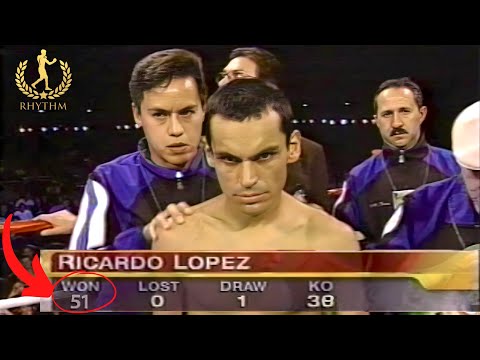
Ricardo "Finito" López. The name itself evokes an era of unparalleled defensive wizardry and surgical offensive striking. To call him merely a "boxer" is to diminish the artistry he brought to the ring. With a flawless professional record of 51 wins (38 by knockout) and zero losses, López wasn't just winning; he was dominating, a three-time world champion across the minimumweight and light flyweight divisions. His moniker, "El Maestro," wasn't bestowed lightly. It was earned through years of meticulous training, an almost supernatural understanding of distance and timing, and a defensive shell so impenetrable it seemed almost mythical. For any aspiring fighter, whether on the mats or in the ring, López's career is a living testament to what disciplined dedication can achieve.

From Mexico City to the Pinnacle: A Fighter's Genesis

Born and raised in Mexico City, López's path to boxing greatness began at a tender age. The environment, while perhaps lacking in conventional martial arts dojos of the East, fostered a raw, competitive spirit that, when channeled through the disciplined structure of boxing, became a crucible for excellence. He turned professional in 1985, and within two years, had captured his first world championship. His career, spanning over 14 years, was a masterclass against some of the era's toughest competitors, including Saman Sorjaturong, Andy Tabanas, and Zolani Petelo. Each victory was not just a testament to his physical prowess, but a demonstration of strategic brilliance.
"The art of boxing is like a dance. You must know when to step forward, when to step back, and most importantly, when not to be touched at all." - A lesson echoed in López's every move.

The Science of Elusion: López's Defensive Masterpiece

What truly elevated Ricardo López beyond the status of a mere champion was his almost unbelievable technique and precision. His stance was textbook-perfect, his footwork fluid and economical, allowing him to control distance with an expert's touch. But it was his defense that became legendary. López possessed an uncanny ability to slip punches, roll with blows, and maintain an upright, active guard that left opponents frustrated and ineffective. For nearly a decade, he went virtually untouched, a feat almost unheard of in the brutal world of professional boxing. This wasn't luck; it was applied physics, timing, and an unparalleled commitment to not getting hit. His style is a profound study in the martial principle of **"Nuki"** (evasion) and **"Uke"** (receiving/blocking), executed with an artistry that is still analyzed and emulated by fighters worldwide.

The Crucible of Training: Dedication Beyond Measure

López's dedication to his craft was not just exemplary; it was absolute. His training regimen was relentless, ensuring he was always in impeccable physical condition. He understood that true mastery in any martial pursuit requires sacrificing comfort for continuous improvement. He was a student of both offense and defense, recognizing that each complements the other. His fights were not simply brawls; they were strategic engagements, thrilling chess matches played out with fists and feet, showcasing a complete understanding of the fight. This unwavering commitment is a core tenet of **Budo Life**, the philosophy that the martial way is a lifelong pursuit of self-improvement.

Veredicto del Sensei: Is Ricardo López's Boxing a Martial Art Worth Studying?

Absolutely. To dismiss Ricardo López's boxing simply because it doesn't involve throws or joint locks is to miss the forest for the trees. His defensive mastery, his precision striking, his footwork that dances on the edge of danger, and his unwavering mental fortitude are all pillars of effective combat. López's career is a compelling argument for the universality of martial principles. His fights are a masterclass in controlling space, managing risk, and executing techniques with devastating efficiency. He embodies the **Warrior Philosophy** and the **Self-Mastery** that all true martial artists strive for.

Rating: Cinturón Negro en Técnica y Estrategia Marcial

Equipo Esencial para tu Entrenamiento

While Ricardo López's technique is invaluable, proper equipment can enhance your training and safety. For those inspired by "El Maestro's" dedication, consider these essentials:
  • Guantes de Boxeo de Alta Calidad: Look for gloves (14-16oz for sparring) that offer excellent padding and wrist support, crucial for emulating López's defensive style without injury.
  • Protector Bucal (Mouthguard): Essential for protecting your teeth and jaw, a non-negotiable for any combat sport training.
  • Vendas para las Manos (Hand Wraps): Provide vital support to your knuckles and wrists, preventing common injuries during heavy bag work or sparring.
  • Cuerda de Saltar (Jump Rope): A staple for improving footwork, coordination, and cardiovascular endurance, mirroring the agility López displayed.
  • Saco de Boxeo (Heavy Bag): For developing power and technique. A quality heavy bag allows you to practice combinations and striking power safely.

Guía de Entrenamiento: El Arte de la Defensa Activa

Inspired by López's impenetrable defense? Here’s a fundamental drill to begin developing your own:
  1. Posición Fundamental (Stance): Adopt a balanced, slightly staggered stance. Keep your lead foot slightly forward, weight distributed evenly, and hands up protecting your head.
  2. El "Slip" Básico: Imagine a punch coming towards your head. Instead of blocking, subtly shift your head to the side, just enough for the punch to whistle past. Practice this movement rhythmically.
  3. El "Roll" o Giro: For hooks or straights aimed slightly lower, bend your knees and use your torso to "roll" with the punch, allowing it to glance off your shoulder or guard.
  4. Combinación de Movimientos: Practice chaining slips and rolls. As one punch is evaded, immediately transition to evading the next, maintaining your balance and guard.
  5. Incorpora el Juego de Pies: As you evade, take small, precise steps to maintain optimal distance or to counter-attack. López never just stood still; his movement was integral to his defense.
  6. Repetición Constante: Perform this drill for 5-10 minutes daily, focusing on fluidity and economy of motion. The goal is to make evasion instinctive.

Preguntas Frecuentes

  • Is Ricardo López's boxing style applicable to other martial arts? Absolutely. The principles of distance management, evasion, timing, and precision striking are universal and can be adapted to disciplines like Karate, Taekwondo, and even Kung Fu applications.
  • What made López's defense so effective? It was a combination of exceptional reflexes, a deep understanding of his opponents' tendencies, perfect timing, economical footwork, and rigorous, consistent training.
  • How did López maintain his undefeated record for so long? Through unwavering dedication to training, meticulous preparation for each opponent, and a defensive capability that minimized damage and maximized his opportunities to win.
  • Can beginners learn from López's style? Yes, but with caution. Beginners should focus on the fundamental defensive movements (slips, rolls) and footwork under the guidance of a qualified instructor before attempting more complex maneuvers.

Para Profundizar en tu Camino

Reflexión del Sensei: Tu Próximo Paso

Ricardo López did not just fight; he *performed* the art of boxing. His "Mexican PERFECTION" is a testament to the fact that in any martial endeavor, the path of discipline, precision, and unwavering dedication leads to a profound understanding of combat and self. The question is not whether you can achieve such mastery, but whether you possess the warrior's spirit to even begin the pursuit. Do you seek mere victory, or do you seek true mastery?
"The difference between a good fighter and a great fighter is not the punches they throw, but the punches they avoid."

Now, contemplate this: How can you integrate the defensive intelligence and precise execution of "El Maestro" into the specific martial art you practice? What concrete steps will you take this week to refine your own evasive techniques and strategic defense? The true test of learning lies not in reading, but in application. Prove your commitment in the dojo, on the mat, or in your solitary training.

If you want to delve deeper into Ricardo López's incredible career and the broader world of martial arts, explore the wealth of resources available online. You can also find related merchandise on our site to commemorate boxing and martial arts legends.

Thank you for reading. We hope to see you back at the dojo (or the digital dojo) soon!

Lamont Peterson vs. Errol Spence Jr.: A Deep Dive into the Knockout Power and Martial Philosophy of Boxing

The electrifying clash between Lamont Peterson and Errol Spence Jr. was more than just a boxing match; it was a testament to the brutal ballet of combat sports and a rich ground for exploring the philosophical underpinnings of the sweet science. As a Sensei with decades dedicated to understanding the nuances of martial arts, from the ancient disciplines of the East to the modern arenas of combat, I approach such spectacles not just as entertainment, but as living case studies in strategy, spirit, and the raw application of force. Welcome, warriors and scholars of the martial path, to Budo and Martial Arts. Today, we dissect the confrontation between Lamont Peterson, the WBA champion known as "Havoc," and the formidable Errol Spence Jr. This encounter, published on March 23, 2023, offers us a potent opportunity to delve beyond the knockouts and the raw power, to examine the martial philosophy that dictates victory and defeat.

The Stage is Set: A Clash of Titans

The professional boxing world, particularly the welterweight division, is a cauldron of talent where strategy, physical prowess, and mental fortitude are tested to their absolute limits. Lamont Peterson, a seasoned warrior with a reputation for resilience and a dangerous left hook, faced Errol Spence Jr., a younger, undefeated prodigy celebrated for his relentless pressure and devastating body shots. This was not merely a fight; it was a narrative unfolding within the 64 square feet of the ring, a story of two distinct martial approaches colliding. The raw statistics and the eventual outcome of the knockout tell only a fraction of the tale. To truly understand a fight like this from a martial perspective, we must peel back the layers. We must consider the individual journeys of these athletes, the styles they’ve honed, and the core principles they embody in their pursuit of victory.

Analyzing the Styles: Peterson's Grit vs. Spence's Precision

Every martial artist, regardless of discipline, develops a unique style forged by their training, experiences, and inherent attributes. In boxing, this translates into distinct approaches to combat. Lamont Peterson, often characterized by his tenacity and ability to absorb punishment, represented a certain brand of fighting spirit, a refusal to yield even when battered. His "Havoc" moniker hints at a chaotic, high-pressure style designed to overwhelm opponents. Errol Spence Jr., on the other hand, exemplified a more methodical, suffocating approach. His fights are often marked by calculated aggression, wearing down opponents with a relentless barrage of punches, particularly to the body, that sap their strength and resolve. This speaks to a different facet of martial discipline: the power of consistent, focused application of technique.
The essence of martial arts is not in the spectacular flourish, but in the disciplined repetition of fundamental principles. Whether striking with a fist, a foot, or a jab, the underlying structure of commitment and execution remains paramount.
Spence’s ability to consistently land damaging shots speaks to superior agility and conditioning, allowing him to maintain a high output over multiple rounds. Peterson's resilience, however, showcased a powerful inner strength and a refusal to be intimidated, qualities central to any true martial spirit.

Knockout Power and the Art of Timing

The term "knockout" evokes images of explosive power, a sudden, decisive end to the contest. In boxing, this is often achieved through precise application of force at critical moments. It's not just about raw strength, but about understanding the opponent's rhythm, their defensive vulnerabilities, and the infinitesimal window of opportunity to land a fight-ending blow. Consider the mechanics: a well-timed punch, delivered with full body weight and rotational torque, can generate tremendous impact. This isn't magic; it's physics and skill. Both Peterson and Spence possessed genuine knockout power, but the difference often lies in the ability to *apply* that power effectively. Spence's success was frequently attributed to his ability to set traps, draw defensive reactions, and then exploit them with explosive combinations. This is a sophisticated form of combat strategy, akin to a martial artist setting up a successful throw or submission. The psychology of timing is also crucial. A fighter who can anticipate an opponent's move and react just milliseconds before they do gains a significant advantage. This often comes from immense mental game development and countless hours of martial arts training, honing reflexes to an almost preternatural level.

The Martial Philosophy Within the Squared Circle

While boxing may seem a world away from traditional Eastern martial arts, the underlying philosophies often converge. The concept of BUDO – the Way of the Warrior – emphasizes not just physical combat, but moral and spiritual development. In boxing, this can manifest as: * **Resilience and Perseverance**: As seen in Peterson's ability to endure, the willingness to continue fighting against adversity is a hallmark of a true warrior. This is the spirit of perseverance. * **Discipline**: The rigorous training, adherence to diet, and commitment to strategy are all forms of discipline that extend beyond the ring. It’s about mastering oneself before mastering an opponent. * **Respect**: While fiercely competitive, true martial artists, including boxers, often show respect for their opponents. The post-fight embrace, the acknowledgement of a worthy adversary, reflects this. * **Strategy and Adaptability**: The ability to adapt one’s tactics mid-fight based on the opponent’s strategy is crucial. This aligns with principles of adaptability found in many martial systems. Spence's methodical approach could be seen as an embodiment of disciplined application, while Peterson's grit speaks to the unwavering spirit.
"The supreme art of war is to subdue the enemy without fighting." - Sun Tzu. While boxing inherently involves fighting, the *most effective* boxing often involves subduing an opponent with overwhelming strategy and pressure, making the final knockout almost inevitable.

The Crucible of Training: Discipline and Conditioning

The performance witnessed in the ring is the culmination of years of relentless training. The training regimens for professional boxers are incredibly demanding, focusing on a blend of: * **Cardiovascular Conditioning**: Essential for maintaining pace and power throughout multiple rounds. Activities like running and skipping rope are fundamental. * **Strength Training**: Building explosive power in the legs, core, and upper body. * **Skill Drills**: Hours spent on punching bags, makiwara (though less common in modern boxing), and sparring sessions to refine technique, timing, and defensive maneuvers. * **Mental Preparation**: Developing focus, resilience, and the ability to perform under immense pressure. The commitment required for such training is immense, demanding a level of self-discipline that few possess. It’s this disciplined approach that separates the contenders from the champions. For those looking to enhance their own training, the principles of conditioning and discipline are universal across combat sports.

Veredicto del Sensei: A Battle of Will and Skill

The Lamont Peterson vs. Errol Spence Jr. bout was a compelling demonstration of boxing as a high-stakes martial art. Spence’s victory, underscored by his potent pressure and knockout power, ultimately showcased a mastery of strategic offense. Peterson, however, proved his mettle, demonstrating the resilience and fighting spirit that defines a true warrior. While the outcome was decisive, the fight itself was a rich tapestry of martial principles. It serves as an excellent example for anyone interested in combat sports and the philosophical depths they can plumb. **Calificación del Sensei:** Un Sólido "Cinturón Negro" en Demostración de Poder y Resiliencia.

Equipo Esencial para tu Entrenamiento

To truly understand the physical demands and refine your skills, having the right equipment is crucial. While boxing has its specifics, many items are transferable across martial disciplines.
  • Guantes de Boxeo (16oz para sparring): Protegen tus manos y las de tu compañero, permitiendo un entrenamiento más intenso y seguro.
  • Vendas para Manos: Indispensables para dar soporte a los nudillos y la muñeca, previniendo lesiones durante golpes potentes.
  • Soga de Saltar: Un componente fundamental para el acondicionamiento cardiovascular y el desarrollo del juego de pies y la coordinación.
  • Ropa de Entrenamiento Cómoda: Permite una total libertad de movimiento, esencial para practicar técnicas de agilidad y velocidad.
  • Protector Bucal: No negociable en cualquier forma de combate que implique golpes.
For those looking to engage with the philosophical side, consider investing in foundational texts on martial strategy and philosophy.

Preguntas Frecuentes

¿Fue este combate una buena representación de la "filosofía marcial" en el boxeo?

Sí, demostró la importancia de la disciplina, la resiliencia, la estrategia y el respeto, pilares de la filosofía marcial, aplicados en el contexto del boxeo profesional.

¿Qué arte marcial se asemeja más al estilo de Errol Spence Jr.?

Su enfoque metódico y su presión constante, combinados con golpes potentes y precisos, podrían compararse con la eficiencia de un practicante avanzado de estilos como el Karate Kyokushin, que enfatiza la contundencia y la penetración.

¿Cómo puede un principiante aplicar la mentalidad de "Havoc" de Lamont Peterson?

Un principiante puede cultivar la resiliencia de Peterson al no rendirse ante la dificultad, al seguir entrenando incluso cuando las cosas se ponen duras, y al enfrentar cada desafío con determinación.

Para Profundizar en tu Camino

Reflexión del Sensei: Tu Próximo Paso

This bout between Peterson and Spence, like any contest in the martial world, offers lessons far beyond the immediate result. It’s a reminder that behind every powerful blow, every resilient stand, lies a lifetime of dedication, a deep understanding of strategy, and an unwavering spirit. The ring, much like the dojo, is a place where character is forged.

Reflexión del Sensei: ¿Tu Próximo Paso?

As you analyze the power, the precision, and the sheer will displayed in this boxing match, ask yourself: In the arena of your own life, what is your most potent weapon? Is it the explosive force of your efforts, or the unyielding consistency of your discipline? Are you a "Havoc" waiting to be unleashed, or a calculating strategist who patiently waits for the perfect moment? Do not merely observe; learn. Apply these martial truths to your own path.

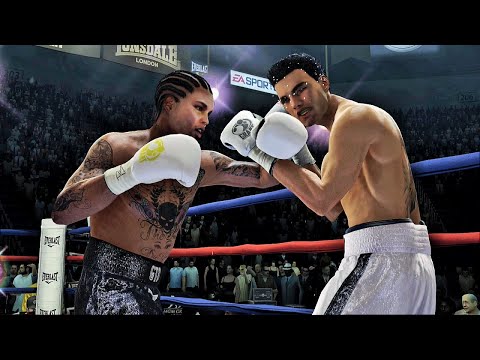
Gervonta Davis vs. Ryan Garcia: A Sensei's Analysis of the Simulated "Fight Night Champion" Bout

Greetings, aspiring warriors and seasoned practitioners. Today, we move beyond the dojo's familiar tatami and the disciplined katas of our chosen arts. We delve into the digital arena, a space where simulated combat can, surprisingly, offer insights into the very principles we hold dear. You've seen the simulated clash: Gervonta Davis vs. Ryan Garcia in the "Fight Night Champion" arena, a digital rendition of a highly anticipated real-world bout. But does this CPU-driven spectacle hold any true martial value, or is it merely a flicker on a screen? Let's dissect it with the critical eye of a true student of the martial way.

Table of Contents

The Simulated Bout: A Surface-Level Look

The raw data is simple: Gervonta "Tank" Davis versus Ryan Garcia, rendered within the "Fight Night Champion" engine. We're presented with a CPU vs. CPU encounter, a deterministic outcome driven by algorithms and pre-set fighter statistics. The immediate appeal, of course, is witnessing a hypothetical showdown between two of boxing's most exciting talents. The "realistic stats" promise suggests a degree of fidelity, a digital echo of their actual fighting capabilities.
However, as practitioners of the martial arts, we know that combat is far more than just statistics. It's about adaptation, intention, the subtle shifts in weight, the breathing, the *kiai*, and the countless hours of brutal, sweaty, and often painful training. A simulation, by its very nature, can only approximate these elements. It's a ghost of the fight, not the flesh and blood.

Intent of the Viewer: What Draws Us to Such Simulations?

Why do we, as martial arts enthusiasts, find ourselves drawn to these digital reenactments? It’s a complex interplay of curiosity, fandom, and a desire to understand potential outcomes. * **Curiosity about Hypotheticals**: The "what if" scenario is a powerful driver. Fans want to see their favorite fighters pitted against each other, even if it’s not a real bout. * **Fandom and Engagement**: We are invested in these fighters. Watching a simulation is a low-stakes way to engage with that investment, to discuss and debate potential results. * **Learning about Strategy (Superficially)**: For some, it's a superficial attempt to grasp the strategic elements – how one fighter's strengths might theoretically counter another's. * **Entertainment Value**: Let’s be honest, a simulated fight, especially with exciting boxers, can be entertaining. It taps into the primal allure of combat sports. But here's where the Sensei's critique must land: while these motivations are understandable, they often come at the expense of understanding the deeper truths of martial arts. Relying on simulations for genuine insight is like trying to learn to swim by watching a documentary about the ocean.

Davis vs. Garcia: Real-World Prowess vs. Algorithmic Representation

Gervonta Davis, known as "Tank," is a powerhouse. His record speaks of devastating knockout power, precise timing, and a granite chin. He embodies the principle of *kime* – the explosive, focused application of power at the precise moment of impact. His style is often described as methodical, grinding down opponents with relentless pressure and a lethal left hand. Ryan Garcia, "The Flash," is a different beast. Blessed with blistering hand speed, remarkable athleticism, and an often-unpredictable flair, Garcia represents a more elusive, agile style. His speed is his primary weapon, capable of overwhelming opponents before they can even react. He often relies on quick bursts and elegant movement. Now, translate this into "Fight Night Champion." The game developers attempt to codify these attributes into numerical values. Davis's power rating might be sky-high, his defense robust. Garcia's speed and agility metrics would likely be exceptional. However, no algorithm can truly capture: * **The Psychological Warfare**: The mental chess match, the intimidation, the ability to absorb punishment and continue, the sheer willpower. * **The Unforeseen Variables**: A fighter having an off night, an accidental headbutt, a referee’s controversial call, a moment of pure inspiration or desperation. * **The Nuance of Movement**: The subtle footwork that sets up a punch, the way a fighter rolls with a blow, the almost imperceptible shift of balance that evades an attack. These are organic, fluid, and incredibly difficult to replicate authentically.
"True martial arts are not about what is seen on the surface, but what lies deep within the spirit." - Unknown Master
This quote resonates deeply here. The simulation shows us the surface – the stylized punches, the simulated damage. It doesn't show the years of sacrifice, the mental fortitude forged in fire, or the primal instinct that takes over in a true life-or-death encounter.

Martial Principles Tested in Silicon: What Can We Learn?

Despite its limitations, can we glean *any* martial value from watching this digital bout? Perhaps, but we must look for echoes of fundamental principles, not direct lessons. * **The Importance of Power Application (Davis)**: If the simulation emphasizes Davis’s knockout power, it’s a subtle reminder of the importance of concentrated force in combat. A well-placed, powerful strike can end a confrontation swiftly. This echoes the concept of *ichi geki hissatsu* – one strike, certain death – a principle often discussed in Karate and other arts. * **The Efficacy of Speed and Evasion (Garcia)**: If Garcia’s simulated speed allows him to avoid damage and land quick combinations, it highlights the defensive and offensive advantages of agility and swiftness. This is a fundamental aspect of many striking arts, where speed can negate an opponent's power and create openings. * **The Clash of Styles**: The simulation inherently presents a clash of styles. This is a universal aspect of combat, whether it's Boxing vs. Muay Thai, Judo vs. BJJ, or Karate vs. Taekwondo. Understanding how different approaches, strengths, and weaknesses interact is a core element of martial strategy. However, we must exercise extreme caution. These are digital representations. The true learning comes from *applying* these principles in physical training, under pressure, with a qualified instructor guiding you.

Essential Gear for the Aspiring Fighter (Beyond the Screen)

While the digital realm offers entertainment, true martial progress requires tangible tools and dedication. For those inspired by the intensity of combat sports, having the right gear is not just about comfort; it's about safety, effectiveness, and a commitment to the craft.
  • Boxing Gloves (10-16oz): Essential for sparring to protect your hands and your partner. The weight depends on the type of training.
  • Hand Wraps: Crucial for wrist and knuckle support during any striking activity.
  • Mouthguard: Non-negotiable for any sparring or live drilling to protect your teeth and jaw.
  • Groin Protector: A vital piece of safety equipment for male practitioners.
  • Headgear: Recommended for high-impact sparring to reduce the risk of concussions and cuts.
  • Quality Training Shoes: Providing grip and support for footwork is paramount.
  • Durable Training Apparel: Comfortable, breathable clothing that allows for a full range of motion is key. Consider specialized gear like karate gis for traditional training.
Investing in quality martial arts merchandise is an investment in your training longevity and safety.

Training Regimen for a Modern Warrior: Bridging Digital and Physical

The "Fight Night Champion" simulation can serve as a spark, but the real fire is ignited through dedicated training. How can you translate the *idea* of these boxers into tangible skills?
  1. Develop Your Power: If you admire Davis's power, incorporate strength and conditioning exercises. Focus on compound movements like squats, deadlifts, and explosive push-ups. Practice striking drills with a heavy bag or makiwara to hone your power application. Remember the concept of Ki or internal energy, which fuels true power.
  2. Enhance Your Speed and Agility: If Garcia's flash appeals to you, prioritize speed and footwork drills. Incorporate ladder drills, cone drills, shadow boxing focused on rapid combinations and evasive movements. Plyometrics and interval training are excellent for building explosive speed.
  3. Sparring with Purpose: The most crucial element. Find a reputable gym that offers sparring sessions. Practice with partners of different styles and sizes. Focus on applying learned techniques, not just winning. This is where you bridge the gap between the simulated and the real. Seek out opportunities to spar with practitioners of grappling arts like BJJ or Judo to understand how to defend against takedowns and ground attacks, a critical element often missing in pure boxing simulations.
  4. Study the Masters: Watch *real* fights, but analyze them critically. Study the footwork, the defensive strategies, the setups for punches, and how fighters adapt. Read biographies of great fighters and martial arts masters.
  5. Cultivate Mental Fortitude: Combat is as much a mental battle as a physical one. Practice meditation, mindfulness, and stress management techniques. Develop self-mastery and the mental game required to perform under pressure.

Sensei's Verdict: Digital Simulation vs. Tangible Skill

Let's not mince words. "Fight Night Champion" is a video game. It's a digital simulation designed for entertainment and engagement within its programmed parameters. It can be a fun way to explore hypothetical matchups and appreciate the *idea* of two great fighters clashing. However, as a tool for genuine martial arts development, its value is limited. It provides a visual representation, perhaps a spark of inspiration, but it cannot replace the crucible of actual physical training, the guidance of a qualified Sensei, the discipline required to master a technique, or the profound lessons learned through sweat, pain, and perseverance. The simulation is a shadow. True martial arts are the substance. While we can analyze the shadows, our focus must remain on cultivating the substance within ourselves. Cinturón Negro en Entretenimiento; Medalla de Bronce en Realismo Marcial.

Frequently Asked Questions

  • Can video game simulations accurately represent martial arts?
    No, they offer a simplified, programmed approximation. True martial arts involve organic movement, strategy, psychology, and years of dedicated practice that algorithms cannot fully replicate.
  • Is it useful to watch boxing simulations like this?
    It can be entertaining and spark curiosity about fighters and styles. However, it should not be mistaken for actual martial arts training or analysis.
  • What are the key differences between simulated combat and real martial arts?
    Real martial arts involve physical conditioning, strategic adaptation in real-time, mental fortitude, the risk of injury, and the profound personal growth that comes from facing genuine challenges.
  • How can I learn more about the actual fighting styles of Gervonta Davis and Ryan Garcia?
    Watch their professional fights, read reputable boxing analyses, and ideally, train in a boxing or similar striking art under experienced instructors.

To Deepen Your Understanding

To truly grasp the nuances of combat and the philosophies that underpin martial arts, look beyond the flickering screen. Explore the real-world application of skill, the history, and the mental disciplines that have been honed over centuries.

Reflexión del Sensei: Tu Próximo Paso

This simulated bout, with its "realistic stats" and CPU vs. CPU drama, presents a fleeting image of conflict. But does it stir the warrior within you to action, or merely lull you into passive observation? When you face your own challenges, whether on the mats or in life, will you rely on pre-programmed responses, or will you draw upon the deep wellspring of your own disciplined effort and cultivated spirit?

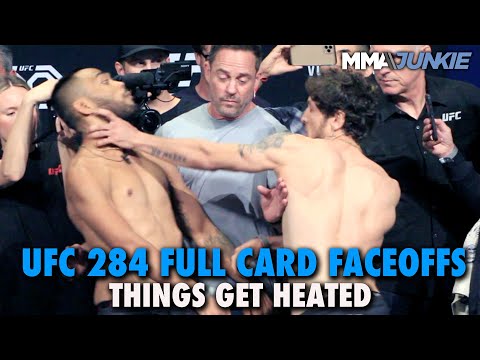
UFC 284 Faceoffs: When Staredowns Escalate to Physical Confrontations - A Martial Artist's Perspective

Hello, warriors, and welcome back to the hallowed halls of Budo and Martial Arts. Today, we dissect an incident that, while ostensibly part of the theatrical build-up to UFC 284, reveals deeper truths about the primal nature of combat and the psychology of the fighter. We're examining the UFC 284 ceremonial weigh-in faceoffs, specifically when the tension between athletes from the 13-fight card transcended mere intimidation and erupted into a physical shove. This event, published on February 10, 2023, at 11:38 PM, serves as a potent reminder that behind every choreographed bout, there lies a raw, untamed spirit. This isn't just about flashy kicks or powerful punches; it's about the mental warfare that precedes the physical. It's about the razor's edge between controlled aggression and explosive confrontation.

The Escalation: More Than Just a Staredown

The UFC 284 ceremonial weigh-ins are designed to be a final, intense confrontation between combatants before they enter the octagon. These faceoffs are theatrical, yes, but they also tap into fundamental aspects of martial arts: the psychological pressure, the assertion of dominance, and the channeling of primal aggression. When a staredown escalates to a physical shove, as it did at UFC 284, it’s not merely an uncontrolled outburst; it’s a breach of protocol that reveals the volatile nature of high-stakes combat. This incident, captured and shared widely, forces us to consider the line between performance and genuine animosity. Did the athletes intend for this to happen, or did the pressure of the moment, the roaring crowd, and the weight of expectation push them over the edge? From a martial perspective, understanding these triggers is crucial.

The Psychology of the Faceoff: A Martial Ploy

In the world of martial arts, the mental game is as significant as physical prowess. A faceoff, or "staredown," is a tactic as old as warfare itself. It's about imposing your will before the first strike is thrown. It’s a display of confidence, a test of nerve, and an attempt to unsettle the opponent. Masters throughout history have understood this. Miyamoto Musashi, in his seminal "Book of Five Rings," alluded to the importance of perception and psychological advantage.
"To win one hundred victories in one hundred battles is not the acme of skill. To subdue the enemy without fighting is the acme of skill."
While the UFC faceoff is not "fighting," it is a precursor, a psychological battleground. The shove at UFC 284 was a failure in this aspect of control. It demonstrated that, for those individuals at that moment, the mental discipline required to maintain the controlled aggression of the martial artist had momentarily yielded to raw emotion. This isn't a criticism of their skill, but an observation of the human element that even highly trained individuals grapple with.

Analyzing the Shove: Technique vs. Emotion

When analyzing the physical aspect of the shove itself, we must distinguish between controlled technique and an emotional reaction. A deliberate, calculated push in a grappling context is different from an impulsive shove born of anger. In the UFC 284 incident, it appeared to be the latter. It lacked the precision of a trained movement and instead resembled a primal reaction. This is a critical distinction for any practitioner of Budo. Martial arts are not merely about physical techniques; they are about cultivating self-control, discipline, and the ability to act decisively without being consumed by emotion. The "Mushin" (no-mind) state, often discussed in Zen and martial arts, refers to a state of mind free from distraction and attachment, allowing for effortless action. The shove at UFC 284, for the individual involved, represented a departure from this ideal.

Cultural Context in Combat Sports

The UFC, being a global phenomenon, is a melting pot of different martial traditions and cultural expressions of combat. While some martial arts emphasize stoicism and respect above all else, others, particularly in modern combat sports, embrace a more flamboyant and aggressive showmanship. The "trash talk" and heated faceoffs are part of the spectacle that draws audiences. This duality is fascinating. On one hand, you have the discipline and philosophy of arts like Karate or Judo; on the other, you have the raw, confrontational nature of MMA. The shove at UFC 284 highlights this tension. It's a performance, yes, but for the fighters, the line between performance and personal animosity can blur under immense pressure. We see this dynamic mirrored in historical rivalries, though often expressed through more formal means like formal challenges or duels.

Philosophical Implications for the Budoka

For the dedicated practitioner of any martial art, the UFC 284 incident serves as a case study. It prompts us to ask: What is the ultimate purpose of our training? Is it solely to win fights, or is it to cultivate a superior character? The philosophy of Budo, encompassing traditional Japanese martial arts, often emphasizes self-mastery as the paramount goal. Winning is secondary to personal development, to becoming a better human being. A moment of uncontrolled aggression, like a shove to the neck during a weigh-in, suggests that perhaps the "self-mastery" aspect was momentarily absent.
"True strength is not in the fist, but in the mind. It is in the ability to control oneself before controlling others."
This principle, though not attributed to a single master, resonates deeply within martial traditions. The UFC 284 incident, while electrifying for spectators, is a reminder for serious martial artists to constantly strive for that inner control.

Veredict of the Sensei: The Raw Edge of Competition

The UFC 284 faceoff confrontation was undoubtedly exciting and a significant talking point for fight fans. It showcased the raw, untamed intensity that makes combat sports so compelling. However, from the perspective of a seasoned martial artist, it represents a missed opportunity for demonstrating superior mental fortitude. While the spectacle is part of the modern fight game, the core of martial arts lies in discipline and respect, even amidst fierce competition. The shove was a moment of emotional overflow, a breach of the controlled warrior's code. It’s a demonstration of passion, certainly, but perhaps not the highest form of martial discipline. **Rating: A Solid Performance in Intensity, but a Minor Foul in Discipline.**

Training Drill: Cultivating Mental Fortitude

To prevent such emotional outbursts from derailing your own progress, consider this drill:
  1. Mindful Staring Contest: Find a training partner. Stand facing each other, a few feet apart. Maintain eye contact without blinking or reacting for as long as possible. Focus on your breathing. If you feel your emotions rising, take a slow, deep breath and return your focus to the present moment. The goal is not to "win" by making the other person break, but to maintain your inner calm.
  2. Controlled Aggression Sparring: During sparring sessions, deliberately practice controlling your impulses. If an opponent makes a mistake, resist the urge to gloat or retaliate excessively. Focus on executing your technique cleanly and efficiently. The aim is to win through skill and strategy, not through intimidation or uncontrolled aggression.
  3. Post-Training Reflection: After each training session, take five minutes to reflect on your emotional state during the practice. Did you feel frustrated? Angry? Did you manage those feelings effectively? Journaling these observations can help you identify triggers and develop strategies for emotional regulation.

Equipment Essential for Your Training

While the UFC incident was about raw emotion, consistent and effective training requires the right gear. For practitioners looking to hone their skills, especially in striking arts like Karate or Kickboxing, investing in quality equipment is crucial.
  • Durable Training Gloves: For sparring and bag work, investing in a good pair of 14oz or 16oz gloves is essential for protecting your hands and your training partners. Look for brands known for their padding and wrist support.
  • Shin Guards: If you're practicing kicking techniques, quality shin guards are non-negotiable to prevent injuries during drills and sparring.
  • Mouthguard: An absolute must for any form of sparring to protect your teeth and jaw.
  • Headgear: For more intense sparring sessions, headgear can provide an extra layer of protection.
  • Dojo Uniform (Gi/Kimono): For traditional arts like Karate or Judo, a well-made, durable Gi is foundational to your training. Look for double-weave options for added longevity in demanding arts.
Consider exploring options for Karate merchandise or robust UFC merchandise to show your support and find practical training aids.

Frequently Asked Questions

What is the main purpose of a UFC weigh-in faceoff?

The primary purpose is to build anticipation and psychological tension for the fight. It's a final staredown designed to intimidate the opponent and engage the audience, but it should ideally remain within the bounds of controlled showmanship.

Is it common for UFC faceoffs to become physical?

While heated exchanges and verbal confrontations are common, outright physical shoves are less frequent but do occur. When they happen, they often signify a loss of emotional control by one or more of the fighters involved.

How does this incident relate to traditional martial arts philosophy?

Traditional martial arts, particularly those emphasizing Budo, prioritize self-control, discipline, and respect. An uncontrolled physical shove would be seen as a failure to uphold these principles, demonstrating that the practitioner is still subject to their emotions rather than in mastery of them.

What is "Mushin" in the context of martial arts?

Mushin, or "no-mind," is a Zen Buddhist concept adopted by martial arts. It describes a state of mind where one's actions are spontaneous, fluid, and free from conscious thought or emotional interference, allowing for peak performance and effective response.

For Deeper Exploration

To truly understand the interplay of physical technique and mental fortitude in combat, delve into these related topics on our blog:

Reflection of the Sensei: Your Next Step

The UFC 284 incident serves as a potent, albeit dramatic, reminder of the human element within the martial endeavor. We saw a flash of raw emotion override practiced control. Now, I pose this to you: In moments of intense pressure, whether in training, competition, or daily life, do you react from a place of disciplined strength, or do you let the storm within dictate your actions? How will you cultivate your inner resilience to ensure your 'faceoff' moments, whatever they may be, are met with the calm authority of a true warrior, not the impulsive outburst of a mere combatant? Reflect on this, and let your actions be your answer.

Brandon Moreno vs. Deiveson Figueiredo IV: The Ultimate Trilogy Decider at UFC 283

Are you ready for the culmination of one of the most captivating rivalries in modern MMA? The air crackles with anticipation, not just for a fight, but for the definitive chapter in a saga that has gripped the UFC community. UFC 283 is poised to host the fourth, and perhaps final, encounter between Brandon Moreno and Deiveson Figueiredo – a true clash of titans that transcends mere competition. This isn't just about a title; it's about legacy, skill, and the unyielding spirit of combat. How did we get here, and what truly separates these warriors as they step into the octagon for a fourth time? Let us dissect this epic confrontation.

The Unfolding Saga

The journey of Brandon Moreno and Deiveson Figueiredo is a masterclass in resilience and evolution. Their first encounter ended in a draw, a prelude to the seismic shifts that followed. Moreno, a fighter renowned for his relentless pressure and **exceptional grappling skills**, shocked the world in their second meeting, submitting Figueiredo to become the first Mexican-born UFC champion. This was a historic moment, a testament to his dedication and the potential of fighters from Latin America. Yet, Figueiredo, a formidable **striker with devastating knockout power**, would not cede his throne easily. He recaptured the flyweight title in a subsequent bout, setting the stage for their rubber match. At UFC 283, the narrative reaches its peak. Each fighter knows the other's strengths and weaknesses intimately. This familiarity, however, does not breed contempt; it breeds a deeper respect and a more strategic approach. The question on every fight fan's mind isn't just who will win, but *how* they will win, and what lessons this final chapter will impart.

Diverse Fighting Styles: Striker vs. Grappler

The beauty of the Moreno vs. Figueiredo saga lies in the stark contrast of their **fighting styles**. Brandon Moreno embodies the modern, well-rounded **grappler**. His ground game is suffocating, characterized by fluid transitions, aggressive submission attempts, and the ability to maintain control even under duress. He consistently aims to take his opponents down, neutralizing their striking threat and wearing them out with positional dominance. On the other side of the octagon stands Deiveson Figueiredo, a pure **power striker**. His hands are lethal, possessing that rare, fight-ending **knockout power** that can turn the tide of any bout in an instant. His movement in striking exchanges can be deceptively simple, but it's effective, leading to openings for his devastating blows. In their previous three clashes, we've seen this dynamic play out repeatedly. Moreno’s strategy often revolves around closing the distance, securing a takedown, and imposing his will on the mat. Figueiredo, conversely, thrives when the fight stays standing, looking to land his heavy shots. The question for UFC 283 is: can Figueiredo effectively defend the takedowns and keep the fight on the feet long enough to exploit Moreno's chin? Or will Moreno continue to implement his **grappling strategy** successfully, dictating the pace and overwhelming "Deus da Guerra" on the ground? This stylistic clash is the core of the intrigue.
"The ultimate martial artist is a craftsman of his own destiny. He is not bound by the limitations of his opponent, but by the discipline of his own practice." - A principle often echoed in the halls of martial arts training.

The Conditioning Factor: Endurance as an Edge

In the high-octane world of MMA, **conditioning** is not merely important; it is often the deciding factor, especially in championship bouts that can go the full five rounds. Both Brandon Moreno and Deiveson Figueiredo are known for their impressive physical capabilities. However, historical trends offer a potential narrative thread for UFC 283. Figueiredo has, on occasion, faced challenges with weight cuts. While a successful weight cut is crucial, the physical toll can linger, impacting a fighter's **endurance** and ability to perform at peak capacity in the later rounds. This is a significant concern when facing an opponent like Moreno, who seems to possess an almost inexhaustible gas tank. Moreno’s **impressive cardio** allows him to maintain relentless pressure, dictating the pace and actively pursuing takedowns and submission attempts even when fatigued. If the fight goes beyond the third round, this **cardio advantage** could become a critical game-changer, allowing Moreno to exploit any waning energy from Figueiredo. This is a key element in **fight analysis**, and many **UFC fans** will be watching to see if Moreno can indeed capitalize on this potential disparity.

The Mental Game: Psychology in the Octagon

Beyond the physical attributes and technical prowess, the **mental game** is a formidable weapon in the arsenal of any elite fighter. The rivalry between Moreno and Figueiredo has been amplified by intense **mind games** and heated exchanges, adding a psychological layer to their physical battles. In their last encounter, Brandon Moreno seemed to possess a distinct psychological edge. His composure and confidence within the octagon were palpable. He appeared unfazed by Figueiredo's usual intimidation tactics, displaying a calm demeanor that allowed him to execute his game plan effectively. Conversely, Figueiredo seemed frustrated, perhaps rattled, and unable to impose his usual rhythm. This psychological advantage is a potent factor. Fighting is as much a battle of wills as it is of skills. Can Figueiredo reclaim his mental fortitude and strike with his customary ferocity, or will Moreno’s psychological dominance continue to be a decisive factor at UFC 283? The **mental strength** required to overcome such a dynamic opponent, especially after several intense bouts, cannot be overstated.

Predicting the Outcome: What the Data Suggests

Predicting the winner in a matchup as closely contested as Brandon Moreno vs. Deiveson Figueiredo IV is a monumental task. Both fighters have proven their mettle, each holding victories over the other. However, by dissecting their previous encounters and analyzing their established strengths, we can infer potential pathways to victory. Moreno's most successful strategy has consistently involved implementing his **grappling** and controlling the fight on the ground. If he can successfully close the distance, secure takedowns, and maintain positional advantage, he has a clear path to victory. His ability to wear down opponents and threaten submissions makes him a dangerous proposition for anyone, including Figueiredo. However, to dismiss Deiveson Figueiredo's **striking prowess** would be a grave error. His **one-punch knockout potential** is always present. A single, well-timed strike can end any fight, regardless of the preceding action. Figueiredo’s ability to land a fight-ending blow means that even if he's losing rounds, he remains a constant threat. This makes the bout inherently unpredictable. Ultimately, if Moreno can replicate his dominant grappling performance while effectively defending Figueiredo's power shots, he stands a strong chance. Conversely, if Figueiredo can keep the fight standing, counter effectively, and land clean, he can secure the victory. This clash at UFC 283 promises to be a thrilling testament to the unpredictable nature of **MMA** and a true test of **martial arts** mastery.

Essential Gear for Your Training

To emulate the dedication and skill displayed by fighters like Moreno and Figueiredo, proper training **equipment** is paramount. Whether you're focusing on striking or **grappling**, having the right gear can enhance your performance and safety. For those aspiring to develop **knockout power** and solid striking fundamentals, quality **boxing gloves** are a must. For **MMA** training specifically, sparring gloves that offer both protection and feel are ideal. If your path leans towards **BJJ** or **Judo**, a durable and well-fitting **gi** is essential. Investing in good training apparel and gear not only improves your practice but also serves as a constant reminder of your commitment to your martial arts journey. Look for reputable brands that specialize in martial arts gear to ensure quality and longevity.

Frequently Asked Questions

Who is the current Flyweight Champion?

At the time of UFC 283, Deiveson Figueiredo was the UFC Flyweight Champion. Brandon Moreno had previously held the title and was vying to reclaim it.

What is Brandon Moreno's fighting style?

Brandon Moreno is primarily known for his exceptional **grappling skills**, including wrestling and Brazilian Jiu-Jitsu, combined with relentless pressure and a strong Muay Thai base.

What is Deiveson Figueiredo's fighting style?

Deiveson Figueiredo is renowned as a powerful **striker**, possessing significant **knockout power**, with a background in wrestling.

How many times have Moreno and Figueiredo fought?

Before UFC 283, Brandon Moreno and Deiveson Figueiredo had fought three times, with one draw, one win for Figueiredo, and one win for Moreno. Their fourth fight at UFC 283 was the rubber match.

What is the significance of the Moreno vs. Figueiredo rivalry?

This rivalry is significant because it's one of the few in UFC history to go to four fights, showcasing a back-and-forth battle for supremacy in a highly competitive division, with both fighters holding the championship title.

For Deeper Insight into Your Journey

* Mastering MMA: Essential Training Tips for Aspiring Fighters * The Art of the Ground Game: Key Grappling Techniques Explained * Unleashing Your Power: Drills to Enhance Striking Force

Reflexión del Sensei: Tu Próximo Paso

The saga of Moreno vs. Figueiredo at UFC 283 is more than just a martial arts contest; it’s a profound illustration of the principles we strive to embody. We see the relentless pursuit of mastery in Moreno's **grappling**, the raw power and spirit in Figueiredo's **striking**, and the mental fortitude required to ascend and remain at the pinnacle. Now, I ask you: In your own training, what is the singular aspect – be it a technique, a conditioning drill, or a mental approach – that you are neglecting, the one that, if honed, could truly elevate your practice to the next level? Have you truly analyzed your own strengths and weaknesses as critically as we analyze these champions? The path to mastery is paved with self-awareness. Confront your own shortcomings.

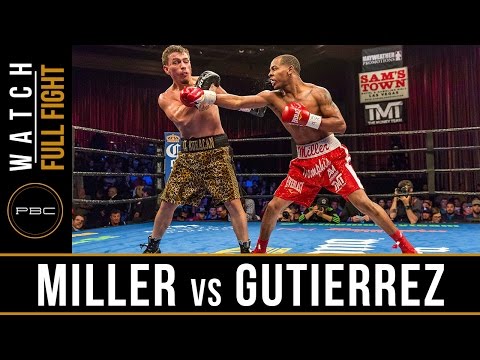
Miller vs. Gutierrez: A Masterclass in Ring Control and Finishing Instinct

The air crackled with anticipation on April 29, 2017, as Ladarius Miller, then a burgeoning prospect with a 13-1 record and 4 KOs, stepped into the ring against the determined Jesus Gutierrez, who boasted a 14-2-1 slate with 4 KOs of his own. This bout, broadcast on PBC on FS1, wasn't just another fight; it was a showcase of ring control, tactical progression, and the often-crucial instinct to finish. Miller's dominant performance culminated in a spectacular eighth-round TKO, a testament to his evolving skill set and the unyielding nature of combat sports. This fight, published on June 30, 2022, serves as more than just a historical record of a boxing match; it’s a dissection of the principles that define martial arts and combat. At Budo and Martial Arts, we don’t just report on fights; we analyze them, drawing parallels between the raw power displayed in the ring and the underlying philosophies that have guided warriors for centuries. From the disciplined approach of Karate to the strategic depth of Judo, the core tenets of control, timing, and decisive action resonate across all disciplines.

The Tactical Blueprint: Building to the Knockout

What distinguished the Miller vs. Gutierrez bout was not merely the eventual outcome, but the methodical approach leading to it. Miller didn't rush; he established his rhythm, using his jab to control distance and gauge Gutierrez's reactions. This patient build-up is a fundamental aspect of many martial arts. Consider the foundational *Kihon* (basics) in Karate, where repetition and precision are paramount before moving to more complex *Katas*. This fight exemplified how a solid foundation, built through consistent application of fundamental techniques, can pave the way for explosive power. Gutierrez, to his credit, showed resilience, weathering early storms and looking for his own openings. However, Miller's ring IQ and physical conditioning proved superior. The ability to maintain composure and execute a game plan under duress is a hallmark of a seasoned fighter, a trait honed through countless hours of dedicated MMA training and general martial arts training.
"The ultimate aim of Karate is not winning or losing, but the perfection of the character of its practitioners." - Gichin Funakoshi
This quote, while specific to Karate, speaks to a broader martial ethos. While Miller achieved victory, his performance also highlighted the character traits of perseverance and strategic execution. Even in defeat, Gutierrez displayed the warrior spirit, refusing to yield easily. This mental fortitude is as crucial as any physical technique, a principle deeply ingrained in the Budo philosophy.

The Art of the Finish: When Theory Meets Practice

The eighth round was a masterclass in finishing instinct. As Gutierrez began to tire, Miller sensed his opportunity. The barrage of punches was not random; it was a calculated offensive, designed to overwhelm and exploit the slightest defensive lapse. This is where the theoretical knowledge of striking, whether from boxing, Muay Thai, or Kickboxing, translates into decisive action. The referee’s immediate stoppage was a testament to the effectiveness and force of Miller's assault, a clear indication that the contest was no longer competitive. This decisive end mirrors the *Kime* (focus, impact) emphasized in many Japanese martial arts. It's the moment where all your training, all your focus, coalesces into a single, powerful action. Whether it's a perfectly timed sweep in Judo, a decisive strike in Karate, or a controlling submission in BJJ, the ability to execute under pressure is what separates practitioners.

The Psychology of Victory and Defeat in Combat Sports

Beyond the physical exchange, the Miller vs. Gutierrez fight offers a compelling case study in sports psychology. Miller's belief in his ability to secure the finish, and his subsequent execution, demonstrates the power of confidence rooted in preparation. For Gutierrez, the challenge becomes one of resilience – how to respond when the tide turns. This mental aspect is often overlooked but is central to the mental game in all combat sports. The pressure of the spotlight, the roar of the crowd, the physical toll – all these factors test a fighter’s mental strength. Mastering these external and internal pressures is a lifelong pursuit for any martial artist, akin to the spiritual development sought in spiritual development.

Veredicto del Sensei: ¿Merece la pena analizar esta pelea?

Absolutamente. While not a legendary clash of titans in the vein of Ali-Frazier, the Miller vs. Gutierrez fight on PBC on FS1 is a valuable educational tool. It clearly illustrates the progression of a fight, the importance of ring control, the power of fundamentals, and the critical instinct to finish. For aspiring boxers, MMA fighters, or anyone interested in the dynamics of striking combat, this bout serves as an excellent example of effective strategy and execution. It’s a practical lesson in how patience and precision can lead to decisive victory. Cinturón Negro en Demostración Táctica.

Equipo Esencial para tu Entrenamiento de Striking

To emulate the discipline and dedication shown in fights like Miller vs. Gutierrez, proper equipment is crucial. Investing in quality gear not only enhances your training but also ensures safety.
  • Guantes de Boxeo/MMA: Essential for protection during sparring and bag work. Consider 16oz gloves for sparring to improve safety and conditioning.
  • Vendajes de Mano: Offer crucial support to wrists and knuckles, preventing injuries.
  • Protector Bucal: Non-negotiable for any form of sparring or combat training to protect teeth and jaw.
  • Zapatillas de Lucha: Provide grip and ankle support, vital for footwork and stability.
  • Casco de Sparring: Protects the head from impact during heavy sparring sessions.
  • Esterilla de Entrenamiento: While more relevant for grappling, a good mat can be useful for plyometrics and conditioning exercises related to striking.
For those looking to enhance their striking power and conditioning at home, consider resources for at-home workouts and bodyweight conditioning.

Guía de Entrenamiento: El Poder del Jab y el Gancho Recto

To capture a fraction of the control Miller exerted, mastering fundamental strikes is key. Here’s a breakdown of the jab and straight cross, foundational punches in boxing and many martial arts.
  1. Postura de Combate: Stand with your feet shoulder-width apart, non-dominant foot slightly forward. Keep your knees slightly bent, weight balanced.
  2. El Jab: From your guard, extend your lead hand straight out, rotating your fist so your palm faces down upon impact. Keep your rear hand protecting your chin. This is your range-finding and control punch. Practice snapping it back quickly to your guard.
  3. El Gancho Recto (Cross): As you throw the cross, pivot on your rear foot, transferring weight forward. Extend your rear arm in a straight line towards your target, rotating your hips and shoulder into the punch. Your non-dominant hand remains up to protect your face. This is your power punch.
  4. Combinación: Practice throwing the jab first, then following immediately with the cross. This is the classic "1-2" combination, a staple in striking disciplines.
  5. Repetición y Ritmo: Execute these punches thousands of times. Focus on speed, accuracy, and snapping the punches. Practice with a partner, on a heavy bag, or with focus mitts.
This disciplined repetition echoes the training philosophy behind Kyokushin Karate and other hard-style disciplines, where conditioning and impact are paramount.

Para Profundizar en tu Camino

Preguntas Frecuentes

  • What was the outcome of the Miller vs. Gutierrez fight? Ladarius Miller won by TKO in the eighth round.
  • On which platform was the Miller vs. Gutierrez fight broadcast? The fight was broadcast on PBC on FS1.
  • How many professional wins did Ladarius Miller have before this fight? Ladarius Miller had 13 professional wins before this fight.
  • What martial arts principles can be learned from this boxing match? Principles such as ring control, strategic patience, the importance of fundamentals, and decisive finishing instincts are all evident.

Reflexión del Sensei: Tu Próximo Paso

This bout highlights that victory is often a result of calculated pressure and seizing opportunity. In your own training, are you merely going through the motions, or are you actively seeking to control the narrative, to build towards your own decisive moments? Do you possess the instinct to finish, or do you falter when the opportunity arises? The ring, like life, demands both preparation and audacity. How will you apply this lesson to your next training session?

Jared Cannonier vs. Derek Brunson: A Masterclass in Striking and Grappling – UFC 276 Analysis

The roar of the crowd, the tension in the air, the palpable energy before a clash of titans – these are the elements that define the pinnacle of combat sports. UFC 276 promises a monumental showdown between middleweight contenders Jared Cannonier and Derek Brunson. But beyond the spectacle, lies a profound study in martial arts strategy, timing, and execution. This isn't just a fight; it's a living, breathing demonstration of principles that have been honed over centuries. At Budo and Martial Arts, we don't just report on fights; we dissect them. We look beyond the knockout power and submission holds to the underlying philosophy and technique. With Cannonier’s stunning victory over Brunson at UFC 271 still fresh in our minds, and his upcoming main event clash against Israel Adesanya at UFC 276 on the horizon, there's no better time to delve into what makes these warriors tick.

The Clash of Styles: Cannonier vs. Brunson

This matchup embodies one of the oldest dichotomies in combat: the striker versus the grappler. Jared Cannonier, a man whose nickname "The Killa Gorilla" is no mere hyperbole, possesses devastating knockout power, an uncanny ability to find openings, and a resilience that has seen him overcome adversity. His striking is a brutal symphony of precision and power, capable of ending a fight with a single, well-placed shot. Derek Brunson, on the other hand, is a quintessential wrestling powerhouse. His game is built on suffocating pressure, explosive takedowns, and a relentless pursuit of control on the ground. Brunson’s strategic approach often involves wearing down his opponents, neutralizing their striking, and dictating the pace of the fight. He embodies the principle that controlling the space and the opponent is paramount.
"The supreme art of war is to subdue the enemy without fighting." - Sun Tzu
While Sun Tzu’s wisdom speaks to strategy outside the immediate fray, within the Octagon, the "fight" is inevitable. The challenge then becomes *how* to fight, and *how* to impose one’s will. Cannonier and Brunson represent distinct yet equally valid paths to victory, and their encounters offer a rich tapestry for martial arts enthusiasts.

The Legacy of Striking vs. Grappling

The dynamic between striking and grappling is as old as organized combat itself. From the ancient Pankration of Greece, where boxers and wrestlers tested their mettle, to the modern MMA landscape, this fundamental conflict has always captured the imagination. It’s a battle of different philosophies: the striking arts, often emphasizing distance, timing, and explosive power; and the grappling arts, focusing on leverage, control, and submission. In the context of Karate, the idea of *ikkaku senjin* (one strike, one kill) highlights the decisive nature of striking. Conversely, Judo, founded by Jigoro Kano, teaches that maximum efficiency can be achieved through skillful application of force, often leading to a dominant position on the ground. The martial arts world has long debated which approach is superior, but the truth, as often is the case, lies in the synthesis and adaptation of both.

Jared Cannonier: "The Killa Gorilla"

Jared Cannonier’s journey in the UFC is a testament to perseverance and the evolution of a martial artist. Initially competing at heavyweight, then light heavyweight, he found his true calling in the middleweight division. This move down in weight allowed him to harness his power more effectively, transforming him into one of the most feared strikers in the division. His striking arsenal is diverse, featuring powerful hooks, uppercuts, and a formidable leg kick that can cripple an opponent. What sets Cannonier apart is his ability to absorb damage and continue fighting, a trait that speaks volumes about his mental fortitude and physical conditioning. His knockout victory over Derek Brunson at UFC 271 was a prime example, showcasing his ability to weather an early storm and deliver a fight-ending blow.
His approach isn't just about brute force; there’s a calculated approach to his offense. He understands distance, timing, and the psychology of striking. When Cannonier connects, it's often with fight-ending finality. This makes him a constant threat, even when he appears to be on the defensive.

Derek Brunson: The Relentless Grappler

Derek Brunson’s background in wrestling is the bedrock of his fighting style. As a Division I collegiate All-American, he possesses a deep understanding of leverage, balance, and control. In MMA, this translates into powerful double-leg takedowns, effective clinch work, and a suffocating top game. Brunson’s strategy often involves closing the distance, securing a takedown, and then grinding his opponent down with ground and pound or relentless positional control. His strength and wrestling pedigree allow him to impose his will, often forcing opponents out of their preferred range and into his territory. He is a master of the "control game," and his ability to dictate where the fight takes place is a significant advantage. He’s also shown significant improvement in his striking over the years, developing a more potent jab and opportunistic power shots, which he uses to set up his takedowns. This evolution makes him a more well-rounded threat, capable of keeping opponents guessing.

UFC 276: A Tactical Breakdown

The upcoming bout at UFC 276 between Cannonier and Brunson is a strategic chess match. For Cannonier, the key will be to keep the fight standing, utilize his superior reach and power, and avoid getting drawn into prolonged grappling exchanges. He needs to employ intelligent footwork, constantly circle away from Brunson’s power side, and land his shots when opportunities arise. A disciplined defense against takedowns will be crucial. For Brunson, the objective is clear: close the distance, secure takedowns, and maintain control. He’ll need to be aggressive in cutting off the cage, defend Cannonier’s powerful strikes effectively, and use his wrestling to put Cannonier on his back. If he can do this consistently, he can nullify Cannonier's greatest weapon and grind out a victory. The question is, who can impose their will? Can Cannonier's KO power find its mark before Brunson can enact his wrestling game plan? Or will Brunson's relentless pressure and takedowns prove too much for the striking specialist?

Beyond the Octagon: Lessons in Budo

The principles demonstrated in a fight like Cannonier vs. Brunson extend far beyond the confines of the Octagon. Budo, the Japanese way of the warrior, emphasizes not just physical prowess but also mental discipline, respect, and continuous self-improvement. * **Mushin (No Mind)**: Cannonier's ability to strike with fluidity, seemingly unburdened by thought, is a demonstration of Mushin. This state allows for instinctive, efficient action. * **Seiryoku Zenyo (Maximum Efficiency, Minimum Effort)**: Brunson embodies this principle with his wrestling. His takedowns are often executed with precise timing and leverage, achieving maximum impact with efficient movement. * **Jita Kyoei (Mutual Welfare and Benefit)**: While the fight is a contest, the respect shown between athletes, the shared pursuit of excellence, and the learning that occurs from such high-level competition ultimately contribute to the growth of all martial artists. These concepts, learned through dedicated entrenamiento and reflection, are what elevate a mere fighter to a true martial artist. The dedication required for such a fight mirrors the discipline needed in any aspect of life.

Essential Training for Elite Fighters

To compete at the highest level, athletes like Cannonier and Brunson require a comprehensive and demanding training regimen. This isn't just about drilling techniques; it’s about building a complete physical and mental foundation.
  • Striking Drills: Focused pad work, heavy bag sessions, sparring to develop power, speed, accuracy, and timing. Emphasis on footwork, head movement, and defensive reactions.
  • Wrestling and Grappling Practice: Live wrestling, positional sparring, submission chaining, and takedown defense drills. Building strength, endurance, and technical proficiency on the ground.
  • Strength and Conditioning: Explosive power training (plyometrics, Olympic lifts), cardiovascular endurance work (sprints, long-distance running), and core strength development.
  • Mental Preparation: Visualization techniques, meditation for focus and calm under pressure, and strategic game planning.
  • Recovery: Proper nutrition, adequate sleep, stretching, and physical therapy are vital to prevent injury and ensure peak performance.
For those looking to improve their own training, consider investing in quality Martial Arts Merchandise like durable kimonos for Judo or Karate, and appropriate protective gear for sparring. A good workout routine can be tailored for home use, even with minimal equipment, focusing on fundamental movements and conditioning.

Veredict of the Sensei: A True Martial Arts Display

The contest between Jared Cannonier and Derek Brunson is more than just a UFC fight; it is a vibrant illustration of martial arts principles in action. Cannonier’s "Killa Gorilla" persona is backed by genuine striking mastery and an iron will, while Brunson's wrestling prowess represents the power of focused, disciplined groundwork. Their previous encounter was a demonstration of how different skill sets can clash, leading to a decisive moment of brilliance. While the result of any single fight can be debated, the dedication, skill, and spirit displayed by both athletes are undeniable. They embody the pursuit of excellence that lies at the heart of all true BUDO and Martial Arts. This fight is a valuable lesson for any practitioner, showcasing the effectiveness of well-honed techniques and unwavering resolve.

Frequently Asked Questions

  • Who won the UFC 271 fight between Jared Cannonier and Derek Brunson?
    Jared Cannonier won by second-round knockout.
  • What is Jared Cannonier's fighting style?
    Cannonier is primarily a striker, known for his devastating knockout power.
  • What is Derek Brunson's fighting style?
    Brunson is a powerful wrestler known for his takedowns and ground control.
  • When did Jared Cannonier fight Israel Adesanya?
    Their fight was scheduled for UFC 276 on Saturday, July 2.
  • Where can I watch UFC fights?
    UFC fights can be watched through UFC FIGHT PASS, ESPN+ (in the U.S.), and other pay-per-view providers.

For a Deeper Dive into Your Journey

To truly understand the depth and breadth of martial arts, it's essential to explore various disciplines and philosophies. Continuous learning is the hallmark of a dedicated practitioner.
  • MMA: Exploring the integrated approach to combat.
  • Karate: Understanding the spirit and technique of striking arts.
  • Judo: Discovering the principles of throws and grappling.
  • History: Learning from the masters of the past.

Reflection of the Sensei: Your Next Step

We have examined the clash of styles, the martial principles at play, and the dedication required for such high-level competition. Now, I pose a question to you, the student: When faced with an opponent whose strengths directly counter your own, do you adapt your strategy, or do you relentlessly pursue your own strengths, hoping to overcome their defenses? Reflect on this, and prepare to demonstrate your answer, not just in theory, but in action, in your own training. ``` GEMINI_METADESC: Explore the martial arts analysis of Jared Cannonier vs. Derek Brunson at UFC 276. Understand striking vs. grappling, Budo principles, and fighter training.